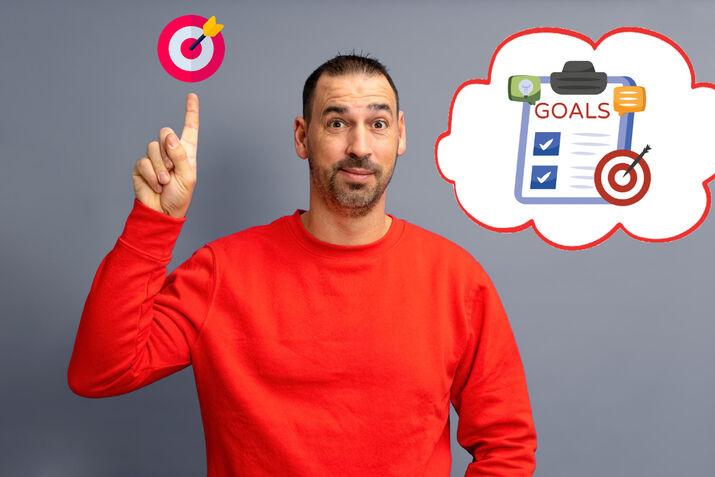
 Goal Setting Vocabulary ESL Lesson
OVERVIEW & OBJECTIVES
This ESL lesson plan on setting goals offers engaging activities, PDF worksheets, and digital materials designed for pre-intermediate A2-B1 students. In this lesson, students will:
- Discuss personal, academic, and professional goals and how they can achieve them.
- Expand vocabulary related to goal-setting, action plans, and everyday routines.
- Study the usage, context, and examples of phrases for setting and achieving goals.
- Practice using verbs like “plan,” “hope,” “intend,” and “make this happen” through sentence exercises.
- Participate in an interactive activity where they set goals, share them with classmates, and plan ways to complete them.
WARM-UP ACTIVITY
Students begin by reading Noah’s list of New Year goals and placing them into categories such as Health, Work, Financial, and Hobbies & Skills. Some goals can fit into more than one category. This allows students to notice differences in specificity and focus while connecting ideas to their own experiences.
Next, students discuss guided questions about Noah’s goals. They identify which goals are specific and which are vague, compare them to their own goals, and consider strategies to complete one or two goals. This encourages reflection and sharing personal experiences in simple English.
Finally, students express agreement or disagreement with statements about goal-setting, such as making goals every year, finishing goals, or writing them down. They also classify verbs into those that mean “to make goals” (achieve, create, set, define) and those that mean “to complete goals” (meet, reach), helping them notice functional language patterns in context.
TARGET LANGUAGE
Students match people’s goals to action plans, noticing how each goal can be achieved in practical ways. One action plan is not used, prompting careful analysis. They also complete a mini-grammar and usage task, choosing correct forms of verbs and prepositions in goal-related sentences. Students write the verb “plan” in the present simple for all pronouns, reinforcing structure and correct usage. These tasks focus on phrases for setting and achieving goals, helping students use the target language naturally.
PRODUCTION PRACTICE
Students complete sentences with verbs in the correct forms, applying phrases like “plan,” “want,” “intend,” and “can achieve this by.” They practice both provided examples and their own ideas, filling in blanks about family, personal, and work-related goals.
In another task, students match goals to images and prompts, saying the goals aloud and forming full sentences with appropriate action plan phrases. This practice ensures they can talk about goals and plans accurately, while using the vocabulary and phrases studied earlier.
GOALS IN ACTION: PLAN, SHARE, & ACHIEVE
Students set their own goals for the week, month, or year using a mind map divided into Health & Wellbeing, Work/Study, Financial, Hobbies/Skills, and Other. They then work in pairs or with the teacher, taking turns sharing goals and ways to achieve them. Students ask questions and give advice using verbs and phrases such as “plan,” “want,” “achieve,” “hope,” “reach,” “intend,” “make this happen,” and “do,” integrating the target language in context.
Finally, students reflect on their goals by answering guided questions, considering new hobbies, financial objectives, habits, potential challenges, and ways to celebrate successes. This encourages practical application and meaningful speaking practice.
BENEFITS OF USING THIS SETTING GOALS ESL LESSON
- Teachers can use this setting goals ESL lesson to help students build confidence in speaking about personal objectives.
- It allows students to expand and apply goal-related vocabulary naturally.
- The lesson improves students’ ability to use functional language accurately in real-life contexts.
- It encourages collaboration and discussion between students, strengthening communicative skills.
- Finally, it provides opportunities to practice forming sentences with verbs and phrases for setting and achieving goals, which supports both accuracy and fluency.
 Lesson Activities
Goals, Plans, Success, Challenges, Habits, Personal Growth
Action, Achievement, Planning, Routines, Strategies
Phrases for Setting and Achieving Goals
Goal Sharing, Quiz & Review, Lesson Reflection
 Lesson Topics
Personal, Health, Work, Financial, Hobbies
Goal Setting Vocabulary ESL Lesson
The Year Ahead: Setting Simple Goals
Functional Skills
 12/31/2025
 2088
2088


UNLOCK FULL LESSON MATERIALS
Buy this lesson to unlock the following materials:
 Printable PDF Lesson Plan
 Interactive PDF Lesson Plan
 Google Slide Lesson Plan
 Teacher's Guide
 Unlock Lesson For $3.49
 Log in
Lesson Plan Preview


Your download is ready. You can open your lesson from your device or in your browser. Enjoy your lesson!
The Year Ahead: Setting Simple Goals
 Like us on facebook
Thanks for your like!
Like us on facebook
Thanks for your like!

 Sign in with Google
 Sign in with Facebook
Do you want to save this lesson to favorites for later?