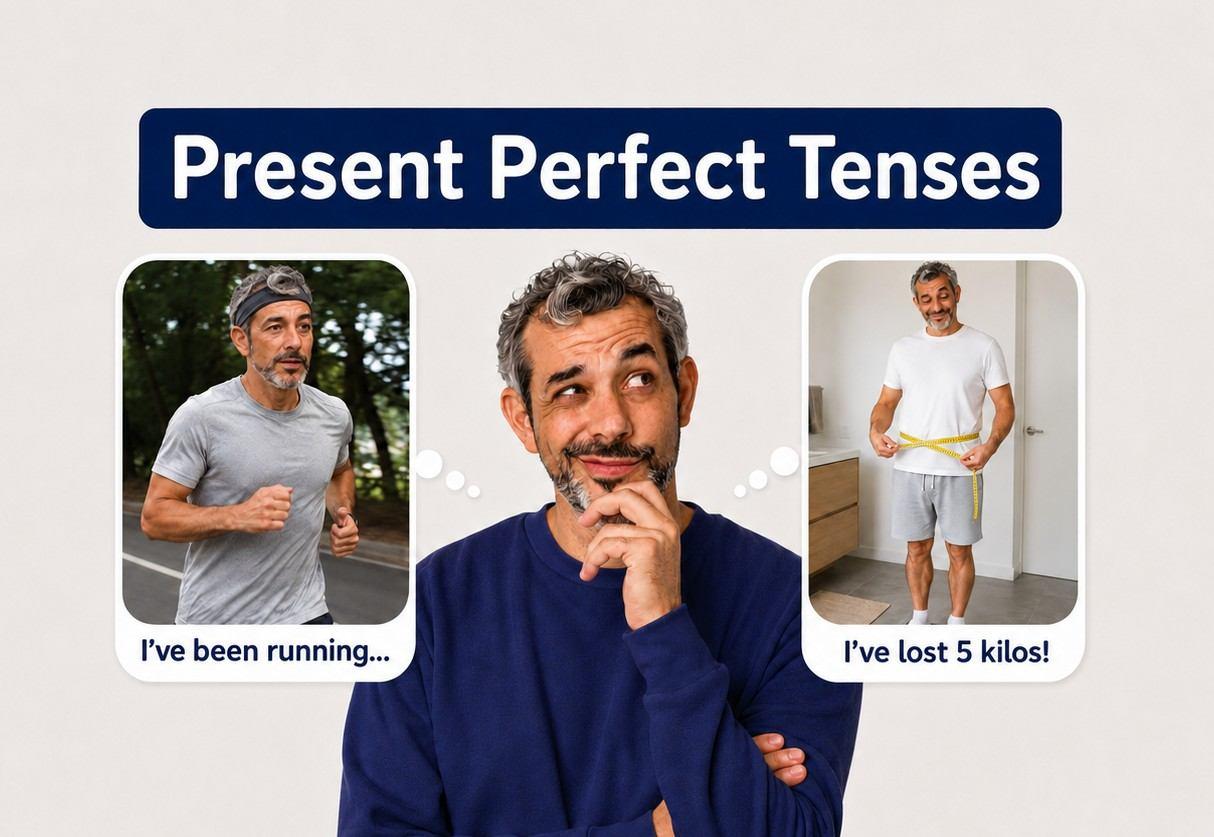
 ESL Lesson Description: Present Perfect Simple vs. Continuous
OVERVIEW & OBJECTIVES
This ESL lesson plan on present perfect simple vs continuous offers engaging activities, PDF worksheets, and digital materials designed for B1-B2 students. In this lesson, students will:
- Talk about long-term and recent habits, challenges, progress, and life updates.
- Identify actions, states, situations, results, and progress in context.
- Study the present perfect simple and continuous with for, since, over, and recently.
- Practice the tenses through sentence completion and guided speaking tasks.
- Share personal life updates and ask follow-up questions using present perfect tenses.
WARM-UP ACTIVITY
In the warm-up activity, students look at images of Alex and discuss his health habits, challenges, and progress, both long-term and recently. They talk about what has been going well for him, what challenges he has had recently, and what might help him overcome these problems. They also connect the topic to their own lives by thinking of health or fitness habits, challenges, or progress from their own experience.
Students then look at a list of ideas related to Alex's life and sort them into actions, states, and results. These include ideas such as running regularly, not smoking or drinking for years, following a meal plan, wanting a fitness watch, losing weight, not sleeping well, and taking care of an injury. This helps students begin to notice the types of meanings that often connect to the present perfect simple and present perfect continuous.
TARGET LANGUAGE STUDY
The target language study begins with a set of sentences about Alex's long-term and recent health situation. Students read the ideas and decide which examples use the present perfect simple and which use the present perfect continuous. The examples include ongoing activities, states and situations, results, achievements, and recent problems, such as running for over five years, following a meal plan since the start of the year, wanting a fitness watch, losing weight recently, and not sleeping well over the last few weeks.
Students then discuss the function of the two tenses. They compare how both tenses connect the past to now, but with different common focuses. The present perfect continuous is used more often for ongoing or repeated actions and activities, while the present perfect simple is used more often for states, situations, results, achievements, completed actions, or amounts connected to now. They also look at the time expressions for, since, and over, and discuss how these time words work with long-term and recent situations.
The final part of the target language study gives students a grammar table. They complete affirmative, negative, and question forms for both tenses. This allows them to compare the structure of the present perfect simple and the present perfect continuous before moving into controlled practice.
PRODUCTION PRACTICE
In the first part of the production practice, students complete sentences with the present perfect simple or present perfect continuous. They choose for or since where necessary. The sentences cover work, living situations, health, hobbies, business, progress, training, and recent habits. Students practice examples such as "I have known my colleague Elena since I joined the company," "Our company has been trying to negotiate new contract terms," and "The language school where my wife works has grown a lot over the last few years."
The second part gives students a semi-controlled speaking task about Martina. Martina is thinking about her life, both long-term and recently. Students say her ideas out loud using the correct present perfect tense and add time points or periods where necessary. The ideas cover where she lives, her job, changing jobs, going out with friends, having a dog, opening a cafe, eating habits, music, piano practice, and English progress.
LONG-TERM & RECENT LIFE UPDATES: PRESENT PERFECT TENSES
Option A asks students to choose a few different areas of their lives and reflect on both long-term and recent situations. They think about work, school, health, fitness, hobbies, family, friends, social life, home, finances, spending, life changes, lifestyle, habits, routines, or other areas. They write ideas in long-term and recently boxes and use the present perfect tenses where possible. They should include both affirmative and negative ideas.
In step 2, students work with a classmate or with the teacher. They share their ideas from step 1 using the present perfect tenses and take turns asking follow-up questions about each other's life updates.
Option B gives students a more guided discussion task. They choose a few topics, form the first question in each set in the correct tense, and then answer and discuss both questions. The prompts focus on what has been going on recently, who they have known for a long time, how long they have lived or worked somewhere, what progress they have made, what they have been learning or practicing, what they have not been doing enough, and what has been going on in the life of someone they know.
BENEFITS OF USING THIS PRESENT PERFECT SIMPLE VS CONTINUOUS ESL LESSON PLAN
- Clear context for present perfect simple and continuous through real life situations.
- Strong grammar support for for, since, over, recently, long-term, and up-to-now meanings.
- Useful contrast between actions, states, situations, results, progress, and achievements.
- Practical speaking tasks for adult and teen ESL students.
- Flexible activation options for both freer discussion and guided question practice.
 Lesson Activities
Health, Fitness, Work, Hobbies, Social Life, Life Updates
Health, Habits, Progress, Challenges, Lifestyle
Present Perfect Simple Vs. Present Perfect Continuous Tenses
Life Updates, Quiz & Review, Lesson Reflection
 Lesson Topics
Progress, Habits, Achievements, Challenges, Relationships
Present Perfect Simple vs. Continuous Lesson
Long-Term & Recent Life: Present Perfect Simple vs. Continuous
Grammar Focus
 06/30/2026
 1124
1124


UNLOCK FULL LESSON MATERIALS
Buy this lesson to unlock the following materials:
 Printable PDF Lesson Plan
 Interactive PDF Lesson Plan
 Google Slide Lesson Plan
 Teacher's Guide
 Unlock Lesson For $3.49
 Log in
Lesson Plan Preview


Your download is ready. You can open your lesson from your device or in your browser. Enjoy your lesson!
Long-Term & Recent Life: Present Perfect Simple vs. Continuous
 Like us on facebook
Thanks for your like!
Like us on facebook
Thanks for your like!

 Sign in with Google
 Sign in with Facebook
Do you want to save this lesson to favorites for later?