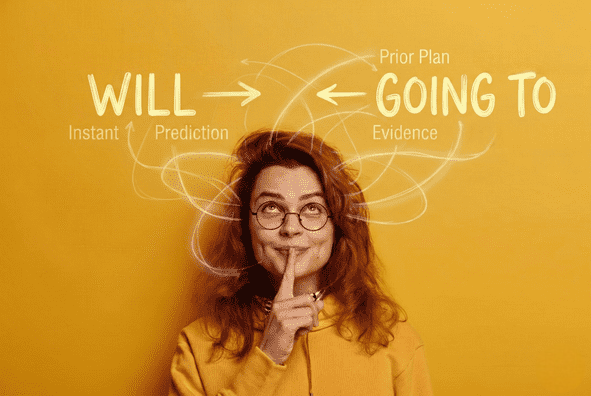
 Will vs. Going To ESL Lesson (Future) Description
OVERVIEW & OBJECTIVES
This ESL lesson plan on will vs. going to and future tenses offers engaging activities, PDF worksheets, and digital materials designed for A2-B1 students. In this lesson, students will:
- Talk about weekly schedules, future plans, and personal intentions.
- Learn vocabulary related to plans, events, schedules, and obligations.
- Understand and compare will vs. going to for plans and predictions.
- Practice the future tense in guided dialogues and structured tasks.
- Use both forms naturally in a role play about future decisions.
WARM-UP ACTIVITY
Students begin by looking at Nik’s weekly schedule and sorting his activities into categories such as Family Activities, Hobbies/Fun, Work, and Other Obligations. They describe what he has planned for the rest of the week and discuss which activities he might be looking forward to or not excited about. The class also reflects on how to describe his schedule using adjectives like busy, organized, or balanced.
Next, everyone shifts the focus to their own lives. Students think about their plans for the next few days and discuss what they are going to do with family or friends, for fun or hobbies, for work or school, and for other obligations. They answer personalized discussion questions about future plans, which prepares them for the will vs. going to future tense lesson plan that follows.
TARGET LANGUAGE STUDY
The grammar focus begins with a dialogue between two friends then introduces the future tense in context. By reading carefully, students identify examples of instant decisions with will, future plans decided before speaking with going to, and two types of predictions. They sort each example into categories such as instant decisions, future plans, predictions based on evidence, and predictions based on opinion. Afterward, they hide the dialogue and correct common grammar mistakes, which reinforces form and word order in the will vs. going to future tense lesson plan.
After that, students make short form and negative transformations using will and going to. Students rewrite example sentences and become familiar with contractions such as I’ll, won’t, and I’m going to. This helps build accuracy before moving into a longer conversation.
PRODUCTION PRACTICE
Students apply what they learned by completing a realistic dialogue about ordering food. They choose between will and going to based on context, such as spontaneous decisions, prior plans, and predictions about delivery time. The situation includes multiple speakers and changing details, which pushes students to think about meaning before choosing the correct form.
In the second task, the focus shifts to a short text about the World Cup. Students complete sentences about future events and predictions using will or going to plus a main verb. The activity includes future schedules, personal beliefs, and time zone differences, which gives them additional controlled practice with the future tense.
MAKING FUTURE PLANS & DECISIONS: ROLE PLAY
Students move into a communicative role play where they create and discuss their own future plans. In Step 1, each student chooses or creates a plan, including the activity, place, and time. They prepare to describe plans already decided, make instant decisions during conversation, and express different types of predictions.
Step 2 focuses on interaction. One student describes their plan while the other responds, asks questions, and reacts using both will and going to. After completing the conversation, students switch roles and repeat the activity. This final stage of the will vs. going to future tense lesson plan allows students to use the target language in a natural and personalized way.
BENEFITS OF USING THIS WILL VS. GOING TO FUTURE TENSE LESSON PLAN
- Clear comparison between will and going to with structured examples
- Strong balance of grammar focus and meaningful speaking tasks
- Realistic dialogues that reflect everyday situations
- Step-by-step progression from controlled to communicative practice
- Flexible activities suitable for adults and teens
 Lesson Activities
Future Plans, Schedules, Predictions, Decisions, Events, Personal Goals
Plans, Schedules, Events, Obligations, Predictions
Future Tense: Will vs. Going To
Role Play Interaction, Quiz & Review, Lesson Reflection
 Lesson Topics
Future, Planning, Decisions, Events, Time
Will vs. Going To ESL Lesson (Future)
Will vs. Going To: Future Plans, Decisions, & Predictions
Grammar Focus
 03/02/2026
 2787
2787


UNLOCK FULL LESSON MATERIALS
Buy this lesson to unlock the following materials:
 Printable PDF Lesson Plan
 Interactive PDF Lesson Plan
 Google Slide Lesson Plan
 Teacher's Guide
 Unlock Lesson For $3.49
 Log in
Lesson Plan Preview


Your download is ready. You can open your lesson from your device or in your browser. Enjoy your lesson!
Will vs. Going To: Future Plans, Decisions, & Predictions
 Like us on facebook
Thanks for your like!
Like us on facebook
Thanks for your like!

 Sign in with Google
 Sign in with Facebook
Do you want to save this lesson to favorites for later?